+49 160 92249176 +33 676 39 39 59


Events


Exhibitions
Standing with Giants
There are places in Normandy where history feels close.
And then there are places where it quietly stands beside you.
At the British Normandy Memorial in Ver-sur-Mer, they return again in 2026.
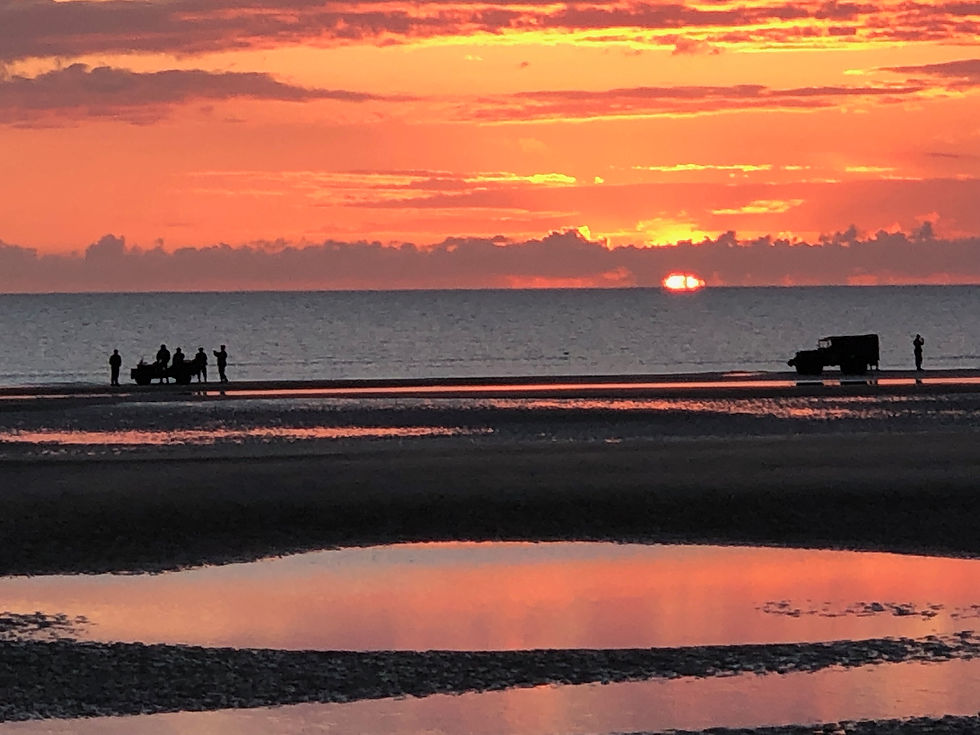
Life-sized silhouettes, standing side by side, facing the sea.
1,475 figures — each one representing a soldier or another person who lost their life in connection with D-Day under British command.
They make visible the stories that often remain in the background: Beach Masters, dog handlers, Royal Navy officers, tank crews, members of the Merchant Navy and the Royal Engineers. And also those who did not fight, but saved lives: medics, commando frogmen — and the only two women. Nurses who lost their lives while trying to rescue 75 men from a sinking hospital ship. There is also a circle of around fifty silhouettes representing members of the French Resistance.
The installation can only be seen for a few months each year. Perhaps this is part of its impact: one does not come across it by chance. One goes there deliberately.
And then you stand there.
Among them.
And suddenly understand the number.
Monuments Men – preserving in silence
Just a few kilometres away, the Overlord Museum tells another, quieter story.
While Europe was being liberated, the “Monuments Men” worked to protect works of art, churches and cultural heritage — and to recover what had been lost.
No battles.
No grand gestures.
But a quiet reminder of what was also at stake.
Perhaps these two places belong together:
One makes the losses visible.
The other reminds us of what could be saved.
Or, more quietly said:
It was not only about land.
But also about memory.

D-Day Festival Normandy
For many visitors, coming to Normandy is not just a trip — it is a way of coming closer to history. Around June 6 each year, Normandy commemorates the Allied landings of 1944 with the D-Day Festival Normandy.
Along the coastline — from the American to the British and Canadian landing beaches — a wide range of events take place: commemorative ceremonies, parades of historic vehicles, exhibitions, concerts, and encounters with veterans and reenactment groups.
The atmosphere is quite unique: solemn, respectful, and at the same time very alive. History is not only told here — it can be felt. We ourselves try to be at Omaha Beach every year on the morning of June 6 at 6:35 am — the moment of the first landings. It is always a deeply moving moment for us.
Some visitors are initially surprised — especially by the presence of military vehicles and uniforms. But what is being remembered here is not war itself, but the liberation of France and Europe from Nazi rule.
If you are staying with us at this time, it is well worth planning to attend one or two events. The programme for the 2026 festival can be found here.
Flea marktets in Normandy
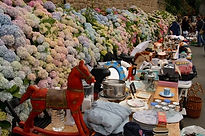
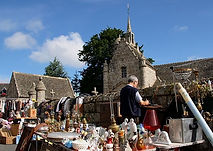
In Normandy, browsing flea markets is almost part of everyday life — or, if you like, a small local pastime. Vide-greniers and brocantes can be found everywhere, often even in the smallest villages.
As many dates for 2026 are already set, it is worth taking a look at a few helpful websites where you can search for events in the area:
-
Particularly clear and well organised. You can filter by region or département (e.g. Calvados), and a small star rating gives an idea of the size of each event.
-
The largest database in France — including even the smallest markets. The map view makes it easy to find events nearby.
-
Ideal for planning ahead, as many dates are listed well in advance.
-
A regional event calendar that also includes festivals and local markets.
A few useful distinctions
-
Vide-greniers are usually private flea markets — a little more informal, often cheaper, and perfect for browsing.
-
Brocantes tend to cater more to collectors, often with professional dealers.
-
Foires à tout are larger markets where you can find everything from antiques to everyday items.
A lovely way to spend a few hours — and sometimes you come across exactly what you weren’t looking for.
Medieval festivals


Les Médiévales de Bayeux
Usually on the first weekend of July, Bayeux transforms for a few days into a medieval world. Around the cathedral and through the old town streets, a lively setting from another time unfolds.
The Médiévales de Bayeux are among the largest medieval festivals in France — and there is much to discover. The weekend traditionally begins with a large parade, followed by an extensive market with numerous stalls offering crafts, regional products, and food prepared according to old recipes.
In between, you may encounter knights, musicians, and jesters, watch demonstrations of traditional crafts, or simply pause because, somewhere nearby, a small piece of history is being played out.
Access to the market and most events is usually free.
A festival you do not need to “visit” — it is enough to simply drift along.
Les Médiévales Saint-Vigor in Cerisy-la-Forêt
Usually on the weekend around July 14, Cerisy-la-Forêt takes on a distinctly medieval character. In 2026, the Médiévales Saint-Vigor are expected to take place on July 11 and 12.
At the heart of the festival is the impressive Abbaye Saint-Vigor, whose ancient walls create a particularly atmospheric setting. Compared to Bayeux, the pace here is a little quieter and more intimate — which is precisely part of its charm.
The strong connection to Norman history is especially noticeable: there is often a Viking camp with demonstrations, crafts, and small glimpses into life at that time. Alongside this, markets, music, and small scenes unfold almost casually between the buildings.
On Saturday evening, there is often a light or fire show, casting the abbey in a very different light.
A small entrance fee is usually charged (around €2 to €5), contributing to the preservation of the abbey.
A festival that is a little quieter — and for that very reason lingers in the memory.